← Somlai-Fischer archive

Kitchen Budapest

2007 Nyár / Summer — the lab’s first catalogue, powered by Magyar Telekom

TransDanube

TransDanube

gprs connection

solar panel

gps + XML DATA

full-page dusk photo of the Danube in Budapest with the Parliament building lit on the right bank; white hand-drawn overlay: computer with globe icon top-left fanning out dashed lines to many small computer icons (the web), satellite with radio waves top-right, dashed orbit line down to a floating boat drawn bottom-centre with gridded solar panel lid, wifi waves labelled 'gprs connection', arrow labelled 'gps + XML DATA'

GPS MODULE

SHIELDS WITH ENVIRONMENTAL SENSORS ON

ARDUINO

POWER SUPPLY

top-down photo into the white plastic boat hull: chipboard base with black tape straps holding electronics; handwritten black labels and circles marking GPS MODULE (small antenna board), SHIELDS WITH ENVIRONMENTAL SENSORS ON (perfboard with wiring), ARDUINO (microcontroller board)
photo into the empty boat hull with a sealed rechargeable lead-acid battery in a wooden frame, circled and labelled POWER SUPPLY by hand

THE BOAT

WEB

DATA SERVER

TRANSMITTER

RECEIVER

white plastic storage-box boat with blue lid, TransDanube label sticker on the side (logo plus small printed instructions in English and Hungarian: 'Please let it flow along Danube / If it gets stuck please throw it again inside the river / Thanks for helping', website http://www.kitchenbudapest.org/, email and phone; HU column 'Kérünk, ne halászd ki / Ha valahol elakad, dobd vissza a Dunába / Köszönjük a segítséget' etc.); handwritten caption THE BOAT
desk photo: blue-lidded box (the boat), Mac mini circled and labelled DATA SERVER with arrow up to circled word WEB, two mobile phones circled and labelled TRANSMITTER and RECEIVER with connecting arrows

Tehát mi a hálózati objektum? Számtalan meghatározást találhatunk a weben, ahány kutató és szerző, annyi definíció: spime, blogjekt, a dolgok internete, mindenütt jelenlévő komputerek, „gondolkodó dolgok”, everyware, környezeti intelligencia stb. Bruce Sterling, a Shaping Things szerzője ezt írja:

„a spime-mal kapcsolatban az a legfontosabb, hogy pontosan meghatározható a térben és időben. Saját történelme van. A spime-ot rögzítik, nyomon követik, lajstromba veszik, és mindig egy történet kapcsolódik hozzá. A spime önálló identitással rendelkezik, egy dokumentált folyamat főszereplője. Kereshető, akár a Google. A spime-ot önkereső objektumként kell elképzelni”

A hálózati tárgyak mibenlétének számos aspektusa van. Általánosságban elmondható, hogy saját identifikációs rendszerük van, mindaddig, míg anyagszerkezettel rendelkeznek, követhetők, kikereshetők, újrahasznosíthatók és képesek meta-adatok létrehozására.

A fogyasztó által létrehozott média és a felhasználó készítette tartalom után úgy tűnik, egy új viszonnyal kell számolnunk, melyet talán a tárgyak generálta tartalommodellnek nevezhetnénk. Julian Bleeckernek a hálózati objektumok manifesztumában is olvashatunk erről:

„A blogjektek legjellegzetesebb tulajdonsága, hogy megosztják a gondolataikat. A blogjektek nemcsak közzé teszik, de terjesztik is a beszélgetéseket. Nem valamiféle mesterséges intelligencia-motor vagy más spekulatív high-tech hókuszpókusz útján. A bloggerekhez hasonlóan a blogjektek is első osztályú beszélgetőkké válnak […] A blogjekt akár egy olyan egyszerű témával is beszélgetést kezdeményezhet, mint a szennyező anyagok felhalmozódása a talajvízben. Ha a beszélgetés nem akad el és óránkénti RSS-váltásban, illetve annak vizualizált formájában folytatódik, akkor a blogjektet nyomon fogják követni”

A nem-dolgok internetét emberek hozták létre, ám a közeljövőben a tárgyak is részt vesznek majd a jelentésalkotásban és a beszélgetős médiumokban. Természetük vonatkozásában a hálózati objektumok számos dolog egybeesésének a következményei. Ilyenek a TCP/IP protokoll, a GPS, a 3D modellező szoftverek, a 3D nyomtatók, a kereső motorok, a rádiófrekvencia azonosító, a wifi, a Bluetooth, az NFC, a mindenütt jelenlévő komputerek, az

After the intense exploitation of the world made of bits, one should take a step back, picking up from the world made of atoms. The networked objects are there, just in between the two worlds, the real mediators. They merge together bits and atoms, and they create new meaning to enrich the knowledge related to the environment and interaction with it. A new relationship is evolving between man and objects. In the world where preservation of production and energy sources holds little power, increased attention must be focused on the quality of the environment and the lifespan of products. We can no longer handle ecology, recycling, sustainability and the environment as merely the watchwords of fashionable activists.

What, then, is a networked object? There are countless definitions available on the web, as many as there are researchers and authors writing about it: spimes, blogjects, Internet of things, pervasive computing, "things that think", everywares, ambient intelligence, etc. According to Bruce Sterling, author of Shaping Things,

"the most important thing to know about spimes is that they are precisely located in space and time. They have histories. They are recorded, tracked, inventoried, and always associated with a story. Spimes have identities, they are protagonists of a documented process. They are searchable, like Google. You can think of spimes as being auto-Googling objects".

Numerous aspects emerge on what a networked object should be. In general, they should contain a unique identification system, as long as they also possess a fabric-structure, are traceable, searchable, recyclable and able to generate metadata.

After the consumer-generated media, user-generated content, we are probably facing a new condition, which might be referred to as an objects-generated content model. This is also considered in Julian Bleecker's manifesto about networked objects:

"The most peculiar characteristic of blogjects is that they participate in the exchange of ideas. Blogjects don't just publish; they circulate conversations. Not with some sort of artificial intelligence engine or other speculative high-tech wizardry. Blogjects become first-class a-list producers of conversations in the same way that human bloggers do. [...] A blogject can start a conversation with something as simple as an aggregation of levels of pollutants in groundwater. If this conversation is maintained and made consequential through hourly RSS feeds and visualisations of that same routine data, this blogject is going to get some trackback".

The first-order consequence of the Internet of Things is a network in which socially meaningful exchanges take place, where culture is made, experiences circulated through media sharing — only with objects and human agents. Whereas the Internet of Non-Things was limited to human agents, in the Internet of Things, objects are also active participants in the creation, maintenance and knitting together of social forma-
A Bruce Sterling által felvetett rendszer szerint a Transdanube-ot spime-nak tekinthetjük, hiszen saját identitása van, talált anyagokból készült, folyamatosan követik a műholdak, és rákereshetünk, ha meg akarjuk tudni, hol tartózkodik pontosan. Környezeti és fizikai meta-adatokat is küld az internetre, ahol bárki érdeklődő hozzáférhet ezekhez.

Ha már blogjektekről beszélünk, a Transdanube projekt másik sajátossága, hogy a hajó elkészíti a saját úti feljegyzéseit. Automatikusan képes szöveget létrehozni egy természetes nyelvalkotó rendszer segítségével, mely az összegyűjtött adatok alapján kiválasztja a megfelelő hangulatokat, kifejezéseket és viszonyokat. A bloggerekhez hasonlóan a blogjektek is első osztályú beszélgetőkké válnak. Ahogy telik az idő a Transdanube folyamatosan tájékoztat majd útjáról, közli a tényeket és a gondolatait – mint a Balkán ELIZÁja.

Ami a Transdanube társadalmi vonatkozásait illeti, szeretnénk bevonni a projektbe a balkáni országok geocacher közösségét is. Biztosan tudjuk, hogy a hajó meg fog állni valahol, mert sziklába, faágba vagy egy nagyobb fadarabba ütközik. Mivel a geocacherek jól értenek a tárgyak követéséhez és megtalálásához, érdemes volna kialakítani velük az együttműködést, mert az segíthetne a Transdanube-nak célhoz érni: eljutni a Fekete-tengerre és eltűnni az óperenciás tengeren.

blogject: neologizmus a blogging object szavak összevonásából, magyarul blogoló objektum vagy tárgy.

URL

http://www.netzfunk.org/?prj=transdanube or Google "transdanube"

as ephemerality is just part of the game. It is our Danube's version of the Voyager I spaceship, and we calculate that by 2020 it will no longer send a signal to the Kitchen Budapest headquarters.

The TransDanube will arouse curiosity and apprehension around its destiny, as it proposes a sort of reality show, with the river and the tiny, fragile, ephemeral boat as protagonists. A reality show that is much more real than the trashy ones on TV.

A website will continually display information and environmental data about the places where TransDanube is located at a given moment: bits and atoms mixed together and available with a single mouse-click. Further contents are then generated thanks to Web2.0 and XML web services: the simple location coordinates will be used to retrieve Wikipedia entries related to the surroundings, local information, weather forecast, geo-referenced pictures, and maps.

GPS data are also used to locate the TransDanube – or the person that picked up the boat. The location, the altitude, and the velocity, together with temperature, light intensity and other values coming from environmental sensors are also used as a feed for some data-visualisation charts.
The overall amount of collected data is then released on the website in XML formats, such as GPX, KML, environmentXML, RSS. Anyone can access the data sources and use them as a feed resource to display information or manipulate it.

According to the scheme proposed by Bruce Sterling, TransDanube can be considered as a spime, since it has a unique identity, it is fabricated with easy to find materials, it is connected and tracked by satellites, and it can be googled in order to know exactly where it is. It also sends environmental and physical meta-data to the internet, publishing them so that they are available to anyone interested.

So long as we are talking about blogjects, another feature of the TransDanube project is that, literally, the boat is able to write its own travel log. It can generate text automatically following a natural-language creation scheme that uses collected data to switch between moods, expression ranges and conditions so as to produce serendipity-based blog posts. Blogjects become first-class a-list producers of conversations in the same way that human bloggers do.

As for the social aspects of the TransDanube project, we aspire to involve the whole geo-caching community of the countries of the Balkans. We are relatively sure that the boat will stop somewhere, because of a rock, a tree branch or a piece of wood. As geo-cachers are very skilled in tracking and recovering objects, a collective participation of people will be created to help the TransDanube to accomplish its final mission: to reach the Black Sea – and to disappear from the operational sea.

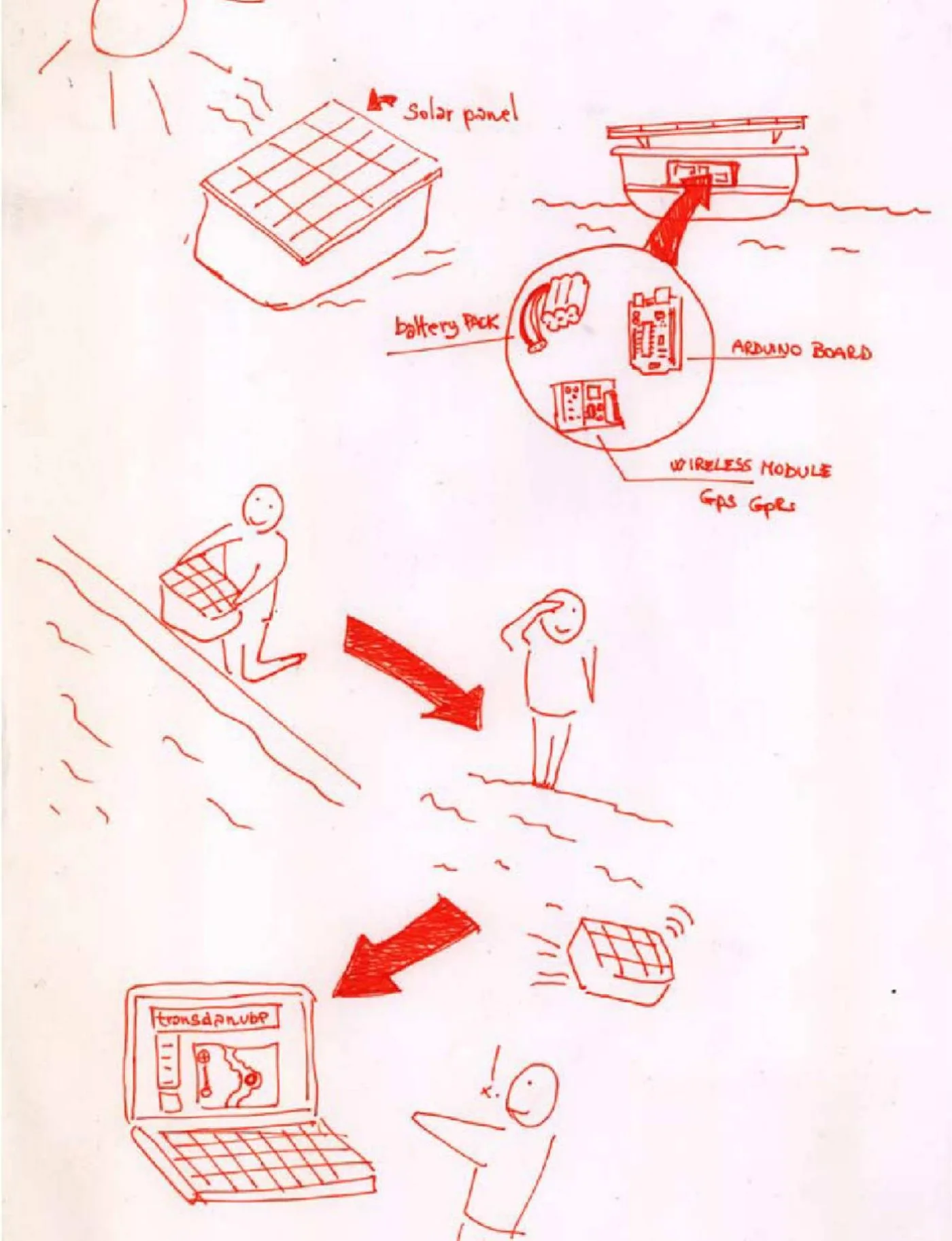
Solar panel

battery PACK

ARDUINO BOARD

WIRELESS MODULE Gps GpRs

transdanube

full-page red ballpoint sketch: sun shining on the boat with gridded solar panel; cutaway detail circle showing battery pack, Arduino board and wireless GPS/GPRS module inside the hull; person launching the boat from a riverbank, another person watching it float; boat drifting with radio waves; laptop showing 'transdanube' website with map tracking; person waving

Restored from the original Kitchen Budapest project site — texts and images as published.