MOME Foundation Board of Trustees
Chair of the board of trustees of the Foundation for the Moholy-Nagy University of Art and Design, 2026–27: a one-year, transitional mandate to guide the university back to full autonomy.
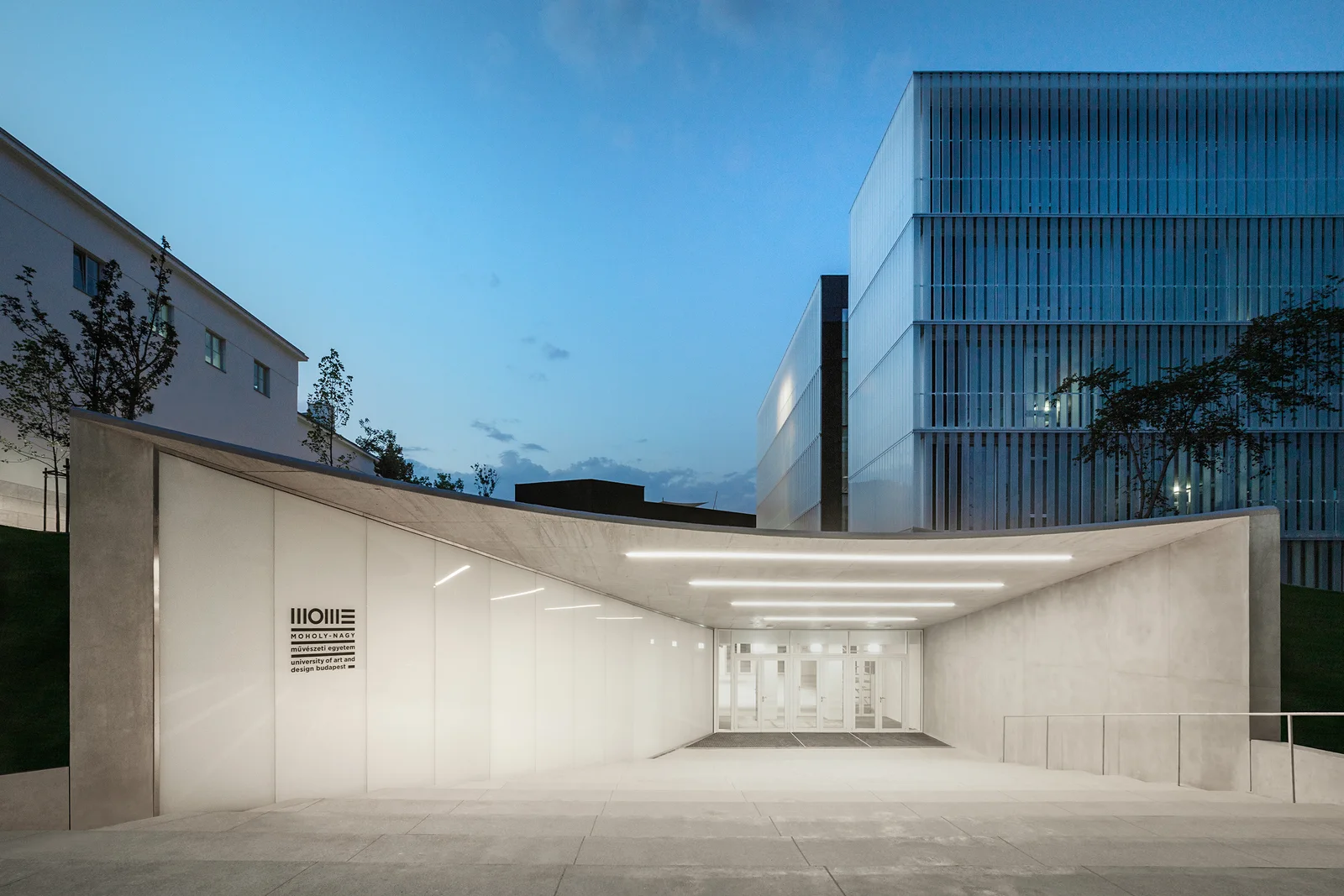
As of September 1, 2026, I serve as chair of the board of trustees of the Foundation for the Moholy-Nagy University of Art and Design (MOME), appointed by the minister for a one-year mandate.
It is an unusual, transitional role: in the year ahead, the foundation-based governance model is being wound down, and the university is regaining its autonomy, step by step. The board's job is to make sure this transition happens in an orderly, transparent way, with the university running undisturbed, and that everything from next year's funding to day-to-day operations stays on solid ground.
While my application was full of propositions, as I came to understand the context better, I also learned where I can help most right now: guaranteeing that this process succeeds, and supporting the university as it begins its next era with full autonomy on stable foundations. It is hard to think of a more noble cause: higher education is a shared good, and I am glad to put my independence and professional experience in its service.
It is a particular joy to serve alongside my fellow trustees: inspiring, deeply knowledgeable people I have already learned from in our very first week. Together with my fellow trustees, we have published our application materials, so anyone can read why each of us took this on. Mine is below.
My application letter
Written for the open call for trustees of the foundation in July 2026, and published with the other trustees' applications. Translated from the Hungarian original.
Dear Members of the Selection Committee,
MOME is a special institution for me. I love and respect what it has achieved: the way it has become, over the past decades, an internationally recognised workshop of Hungarian design culture, and the way it has raised generations of creative, thinking people. This is why I am applying: I would like to help MOME regain its independence in the transitional year that is now beginning, and at the same time, in dialogue with everyone involved, help shape an operating structure that sets the university on the path to global excellence in the medium term. I would like to serve an institution whose students answer the challenges of our shared future with sensitivity and beauty.
❦
I am first and foremost a designer. I developed Prezi as a designer, for my own lectures: the product experience and the visual language were born of my own creative needs; Péter Árvai and Péter Halácsy joined me later, and together with my co-founders we took a visual idea to worldwide success. Prezi is today one of the world's best-known products to have started from Hungary, with around 150 million users, an exceptionally large share of them students and teachers. I believe this way of thinking is the closest to how MOME itself works: I approach problems as a designer and a maker, not primarily as an entrepreneur. As a media artist I have exhibited four times at the Venice Architecture Biennale, most recently in 2025 with our family exhibition in the Hungarian Pavilion, and my work has been covered by Wired, The New York Times, the Financial Times, Forbes and CNN, among others. I live in a family of designers: my wife is an architect, and our children are finding their way toward design and the fine arts.
Alongside my design work, I have served Prezi for twenty years as an owner and board member: I have been part of every stage of building an international company, of its maturing and its strategic turns, so I know the responsibilities and the toolkit of board work from practice. Over the past two decades Prezi's team has typically been between 100 and 300 people, an organisation comparable in size to MOME's community of faculty and staff: I know from the inside how communities of this size work, their dynamics and the responsibility of leading them.
I have also built an institution: the Kitchen Budapest media lab was born of my idea, and as founder and program director, together with Péter Halácsy, Péter György and Robin Nagy, we brought it to international recognition in less than a year. The core of the model was interdisciplinary teamwork and a creator-owner mindset: everyone the passionate owner of their own project, yet creating together, as a community. It is a particular joy to me that the lab remains a living point of reference in the MOME community to this day. I was also a co-founder of Bridge Budapest, and I took part in founding Budapest School. I have taught and lectured at the world's leading design and architecture schools, from KTH in Stockholm to the Royal College of Art in London and the MIT Media Lab; in 2024, at the Cumulus conference hosted by MOME, I spoke about the future of design education as a plenary speaker of the international association of design education.
❦
I imagine the work of the board as a collaboration: I look forward, with an open mind, to learning the intentions and ideas of my fellow trustees, the university community and the ministry. At the same time, I think it is important to share in advance the convictions I would bring to this shared thinking. There are three.
The first is academic freedom: the university must be independent of the political actors of the day. At the same time, the state as owner has an important role in guaranteeing that the highest ethical and legal standards prevail, holding a bar that goes beyond the self-regulation of internal collegiality; I believe this is, in part, precisely the job of the governing body. There is a nuance to this: I am a believer in high ethical standards, but not in public shaming or cancel culture. People must be given the chance to recognise their mistakes, apologise, learn and change; the bar must be held all the while. And social diversity belongs here too. A third of Hungary lives in scarcity, while the strong, original ideas of art and design often come from surprising corners of society, from many kinds of personal stories. I believe the state should set the expectation that institutions running on public money work consciously so that the most varied layers of our society find their way to them. This is not only a matter of fairness: it is also a source of creative quality.
The second is professional standards. I believe the university's atmosphere and purpose should be the pursuit of the highest possible level in art, design, culture and all related creative work: a strong presence at the front line of international discourse and a real impact on the global conversation, while the institution draws on local values, customs and stories. Most of the tasks, challenges and cultural contexts in which MOME's students will create will be international and interdisciplinary. That is why I would give particular support to the university connecting to international knowledge exchange in a professionally fresh, credible and open way: inviting, joining, exchanging and learning.
The third is openness to the future. Most students of an applied arts and design university will work as applied creators, in fields that are transforming before our eyes, in the age of AI, at a pace never seen before. I see a great opportunity in this for MOME. I would like to support a governance structure that makes the institution agile: capable of responding finely and quickly to changes in the world, and of opening confidently toward new fields by building on its strengths at any given time, while the academic community remains the natural owner of decisions. This is where I can help the most, because my career has been about making innovation happen: from Prezi's continuous product renewal to leading its AI-native platform shift in recent years, and to building Kitchen Budapest. What I have learned from these is that renewal takes root where good intentions are supported by good structures.
I also think it is important to raise an open question, because the call does not make it clear, and I believe the basis of good collaboration is that the parties understand the role in the same way. The board's task may be primarily legal and guarantee-like in nature: ensuring a lawful, orderly transition, while the design of the new governance structure is the joint work of the university and the ministry. But it may be more than that: active, creative participation in ensuring that MOME begins its next era in the best possible governance structure. Both readings are legitimate; for my part, I see the real opportunity in the latter, and that is where I could add the most. I would consider it important that a shared, explicitly stated picture of this emerges before the appointment.
❦
I am aware of the one-year, fixed-term nature of the mandate, and it is precisely this task that I am taking on: personal, active participation in the work of the board, ensuring the undisturbed operation of the university, the orderly return of governance rights to the institution, and responsible participation in the lawful and transparent winding-up of the foundation, in close cooperation with the senate, the rector and the ministry exercising the founder's rights.
Thank you for considering my application. It would be an honour to serve the MOME community with my experience in this important year.
Budapest, July 18, 2026
Adam Somlai-Fischer